Dome Mountain
Mining commenced at the adjacent Dome Mountain Mine in December 2025 (please refer to the BLLG website for all information pertaining to this). A 3% NSR granted to the Guardsmen when it sold several claims to Gavin Mines (now BLLG owned), will be applied to metal production when mining operations begin on those claims.
Our Dome North High-Grade Gold Veins on Claims adjacent to the west side of Blue Lagoon’s Dome Mountain Mine
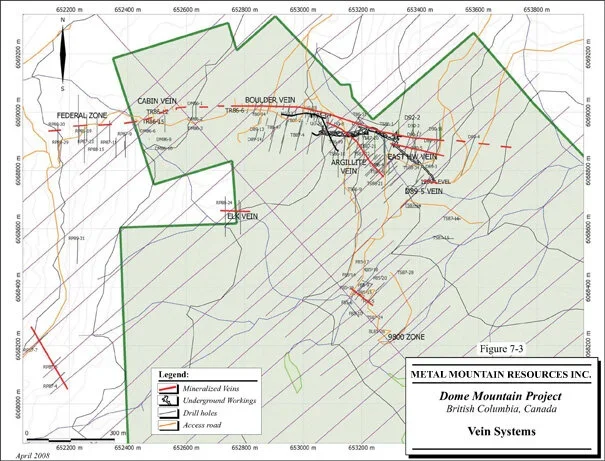
The Dome North property is 32km S-SE of Smithers, B.C., and covers 3585 hectares on ten (10) contiguous road accessible mineral claims that are owned 100% by Guardsmen Resources Inc. Guardsmen also owns a 3% NSR on most BLLG strategic claims adjacent to the producing Dome Mountain Gold Mine operated by Blue Lagoon Resources.
Dome North is underlain by three main formations of the Lower to Middle Jurassic Hazelton Group: the basal Telkwa Formation, the intermediary Nilkitkwa Formation, and the overlying Smithers Formation. Mineralization on the property and on the adjacent Dome Mountain Gold Mine consists of polymetallic quartz-carbonate veins that occur within a 12km, roughly NW trending band within which veins run NW-SE or E-W. There are at least 14 veins within the vicinity of Dome Mountain. The veins contain up to 10% sulphides including pyrite, sphalerite, chalcopyrite, galena, tetrahedrite and arsenopyrite. The main Boulder vein system extends west toward the Dome North property.
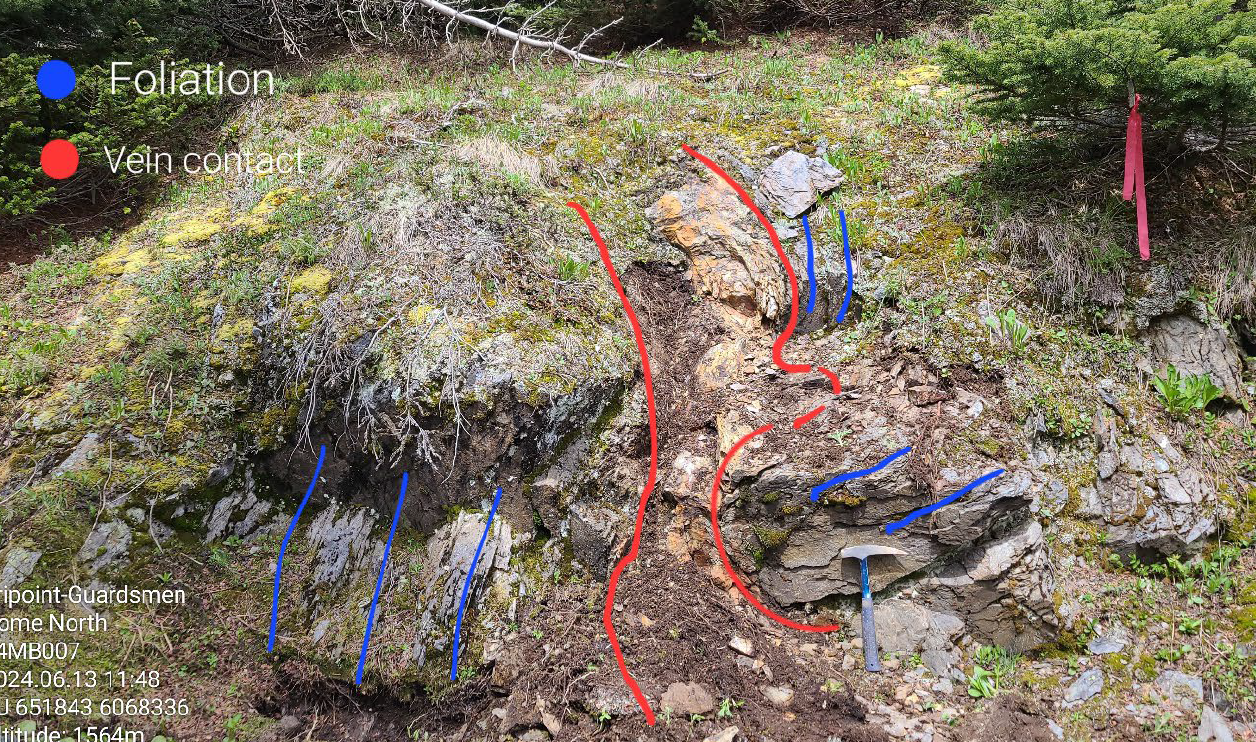
The Jane Vein is the main prospect on Dome North. It occurs within strongly foliated tuffs of the Telkwa Formation as a 0.3-1.3m wide quartz-carbonate vein with shattered pyrite and chalcopyrite. In 1984, a 1.5m chip sample taken across the vein graded 68.6 g/t Au & 140.6 g/t Ag. In 2000, 28 samples of vein and altered wallrock were collected from a 75m drift on the Jane Vein with values ranging up to 58 g/t Au & 91 g/t Ag.
In 2022-2024 Guardsmen completed a 1000 sample soil grid adjacent to the Jane Vein near the tenure boundary shared with Blue Lagoon. Anomalous zones were identified with elevated values in Au, Ag, Cu, Pb, and Zn. These spot anomalies, together with rock sampling of several bed rock showings traced the NW extension of the Jane Vein and identified Hoopes vein mineralization. Rock results for the Jane vein included: 25.9 g/t Au, 80.2 g/t Ag & 1.66% Cu and 10.8 g/t Au, 83.4 g/t Ag & 0.78% Cu from two different 1m wide vein occurrences. Rock results for the Hoopes vein included: 20.3 g/t Au, 298 g/t Ag & 1.93% Cu from a 1.5m wide vein. These zones are scheduled for additional work in 2025.
Late in 2025, Blue Lagoon’s underground Dome Mountain Mine commenced operations at a mining rate of 100 tonnes per day, and expects to increase to 150 tonnes per day in 2026 with the addition of a second production shift. The mine has a measured mineral resource of 136,000 tonnes grading 10.32 g/t Au & 57.31 g/t Ag, an indicated mineral resource of 662,000 tonnes grading 8.15 g/t Au & 41.19 g/t Ag, and an additional inferred mineral resource of 85,000 tonnes grading 6.02 g/t Au & 26.13 g/t Ag. The measured + indicated categories contain 218,000 ounces of gold and 1.126 million ounces of silver. In addition, considerable exploration potential exists well beyond the extents of the established resources. Results included: 7.31m grading 14.8 g/t Au & 38.3 g/t Ag, and 1.73m grading 30.67 g/t Au & 99.26 g/t Ag on the Chance Vein; 1.09m grading 31.67 g/t Au & 473.0 g/t Ag and 4.63m grading 6.99 g/t Au & 24.6 g/t Ag, and 16.55m grading 5.49 g/t Au, 80.9 g/t Ag & 1.21% Cu on the Boulder Vein.
The implications of continued success by Blue Lagoon at its Dome Mountain Gold Mine are that the immediately adjacent claims, on which GRI holds a 3% NSR, become increasingly valuable, as do claims that comprise Guardsmen’s adjacent Dome North property, which itself merits continued exploration. Guardsmen is securing drilling permits for the Jane prospect.